January marks the start of a new year, with many people using this time as a fresh start and the perfect time to set health-improving goals. A study in 2024 found that January is the most popular month of the year for people to give up smoking, with an average of 440,670 online searches for terms related to quitting smoking1.
New Year’s resolutions can be health-focused or financially driven, and quitting smoking aligns perfectly with both. Not only does it improve overall health, but it also saves significant money, allowing people to achieve their financial goals.
Understanding CO monitoring.

Carbon monoxide is an odourless, colourless, and tasteless gas that is produced during incomplete combustion. This gas is found when smoking tobacco and has a profound effect on people’s health. When inhaled, CO binds to haemoglobin in red blood cells, reducing the delivery of oxygen throughout the body2. Smokers typically have high CO levels, and this can be monitored through a CO monitoring device used to aid a quit-smoking attempt.
The role of CO monitoring in quitting smoking.
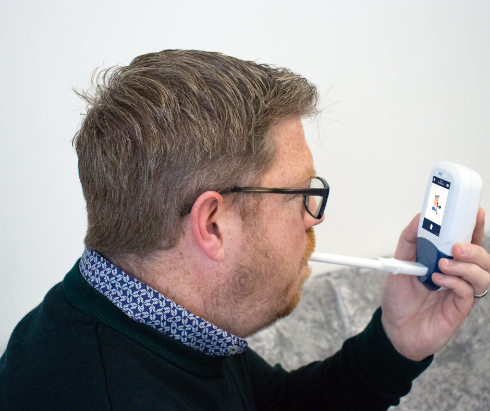
A CO monitoring device, like the Smokerlyzer®, measures the levels of CO on exhaled breath, establishing a person’s smoking status. The device offers a simple test: the user exhales slowly into the device to receive an instant CO reading, providing tangible feedback. Using a CO monitoring device during a quit attempt empowers the user to take control of their own health and, by seeing their CO levels drop over time, motivates them to continue their quit attempt.
The Smokerlyzer® range.
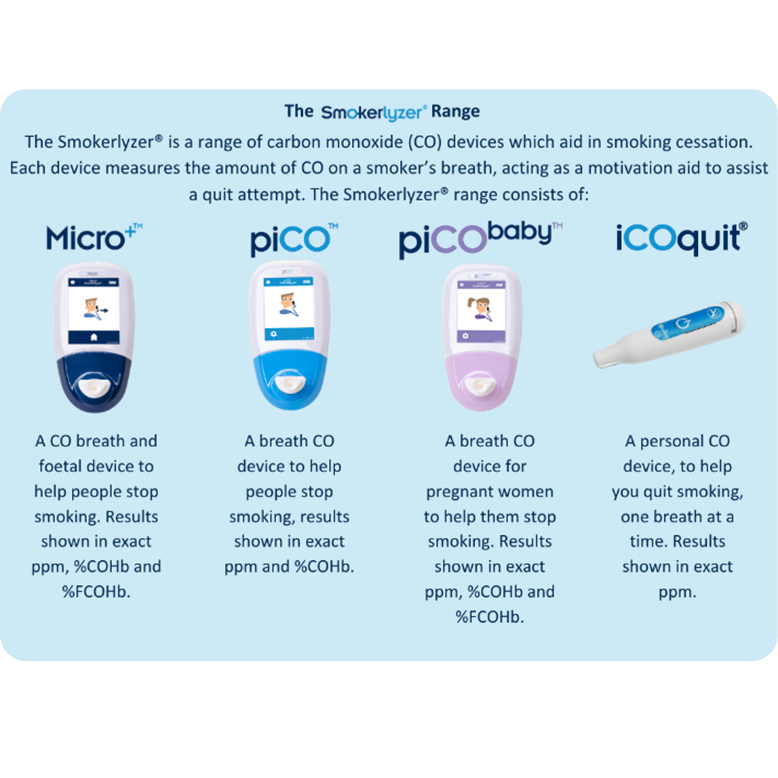
- Micro+™ – a CO breath and foetal %COHb %FCOHb device providing instant results, in parts per million (ppm), to help people stop smoking.
- piCO™ – a breath CO device, providing instant results in exact ppm and %COHb to help people stop smoking.
- piCObaby™ – a breath CO device for pregnant women to help them stop smoking, providing instant results in exact ppm, %COHb and %FCOHb.
- iCOquit® – a personal CO device, which can be used at home to help you quit smoking.
Setting realistic quit goals.
Quitting smoking doesn’t happen instantly; it is a process, and like any significant lifestyle change, it works best when you set clear, achievable goals. A structured approach can help you stay focused, track progress, and celebrate success along the way. A helpful way to plan your quit journey is to make your goals SMART.

- Specific – Be clear about what you want to achieve.
- Measurable – Use CO readings or smoke-free days to track progress.
- Achievable – Set goals that challenge you but are realistic.
- Relevant – Focus on why quitting matters to you.
- Time-bound – Set a timeframe for your targets.
Tracking progress and staying motivated.
Measuring CO levels during a quit attempt provides users with visual feedback; watching CO levels drop is a powerful motivator that helps people continue their journey. CO monitoring is also helpful in identifying relapses early and prompting users to get back on track. Quitting smoking is notoriously difficult, and it is important to celebrate milestones during a quit journey. Lower CO readings and smoke-free days are worth celebrating.
January provides the perfect opportunity to make positive, lasting changes, and quitting smoking is one of the most powerful steps you can take for your health. CO monitoring allows you to see tangible proof of your progress from the very first days of your quit journey. Watching CO levels drop is a reminder that your lungs are healing, your oxygen levels are improving, and your body is recovering.
Whether you are cutting down gradually or quitting altogether, setting clear goals, tracking your results, and celebrating each milestone can keep you motivated and on track. For more information on the Smokerlyzer® range and how it can aid a quit-smoking attempt, visit the website here.
References
- Leah. New study reveals the most popular times of year to quit smoking – Digital Health Technology News [Internet]. Digital Health Technology News. 2024 [cited 2025 Nov 6]. Available from: https://www.healthtechdigital.com/new-study-reveals-the-most-popular-times-of-year-to-quit-smoking/
- Cancer Research UK. What’s in a cigarette? [Internet]. Cancer Research UK. CRUK; 2023. Available from: https://www.cancerresearchuk.org/about-cancer/causes-of-cancer/smoking-and-cancer/whats-in-a-cigarette-0